Red Lotus Lake, Kumphawapi: Udon Thani's Sea of Flowers

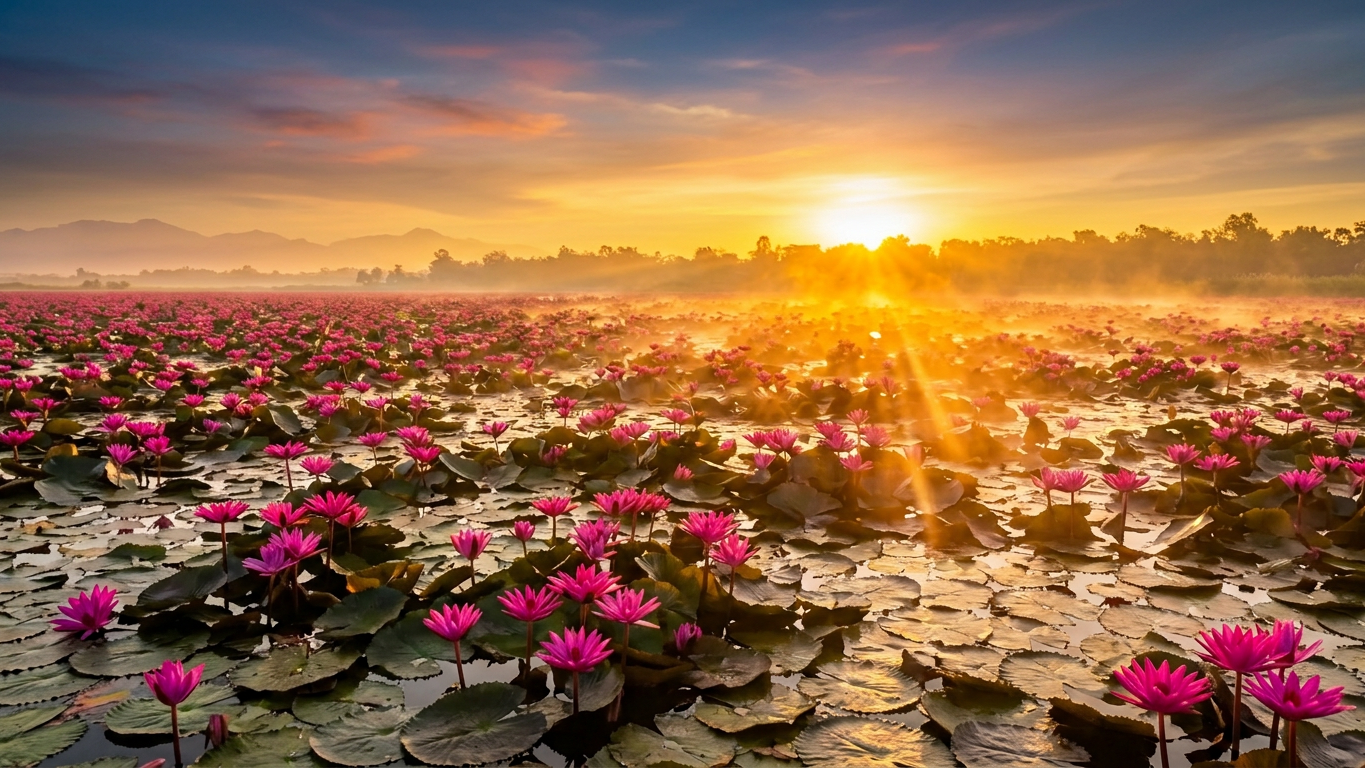
There are some places in Thailand where you arrive and immediately realise that photographs really don’t do them justice.
Red Lotus Lake in Kumphawapi, Udon Thani, is one of them.
Known locally as Talay Bua Daeng (ทะเลบัวแดง), the lake can transform into a huge carpet of red and pink lotus flowers when they’re in bloom.
It’s one of the most unusual natural sights I’ve come across in northeastern Thailand - and definitely one that deserves to be seen from the water.
So, naturally, I took the camera along.
Watch the video
What is Red Lotus Lake?
Red Lotus Lake is the popular English name for Talay Bua Daeng, a huge wetland area in Nong Han Lake, near Kumphawapi in Udon Thani Province.
And despite the name, these aren’t really red lotus flowers in the traditional sense. The lake is famous for its masses of pink and red water lilies, which can cover large areas of the water when they’re flowering.
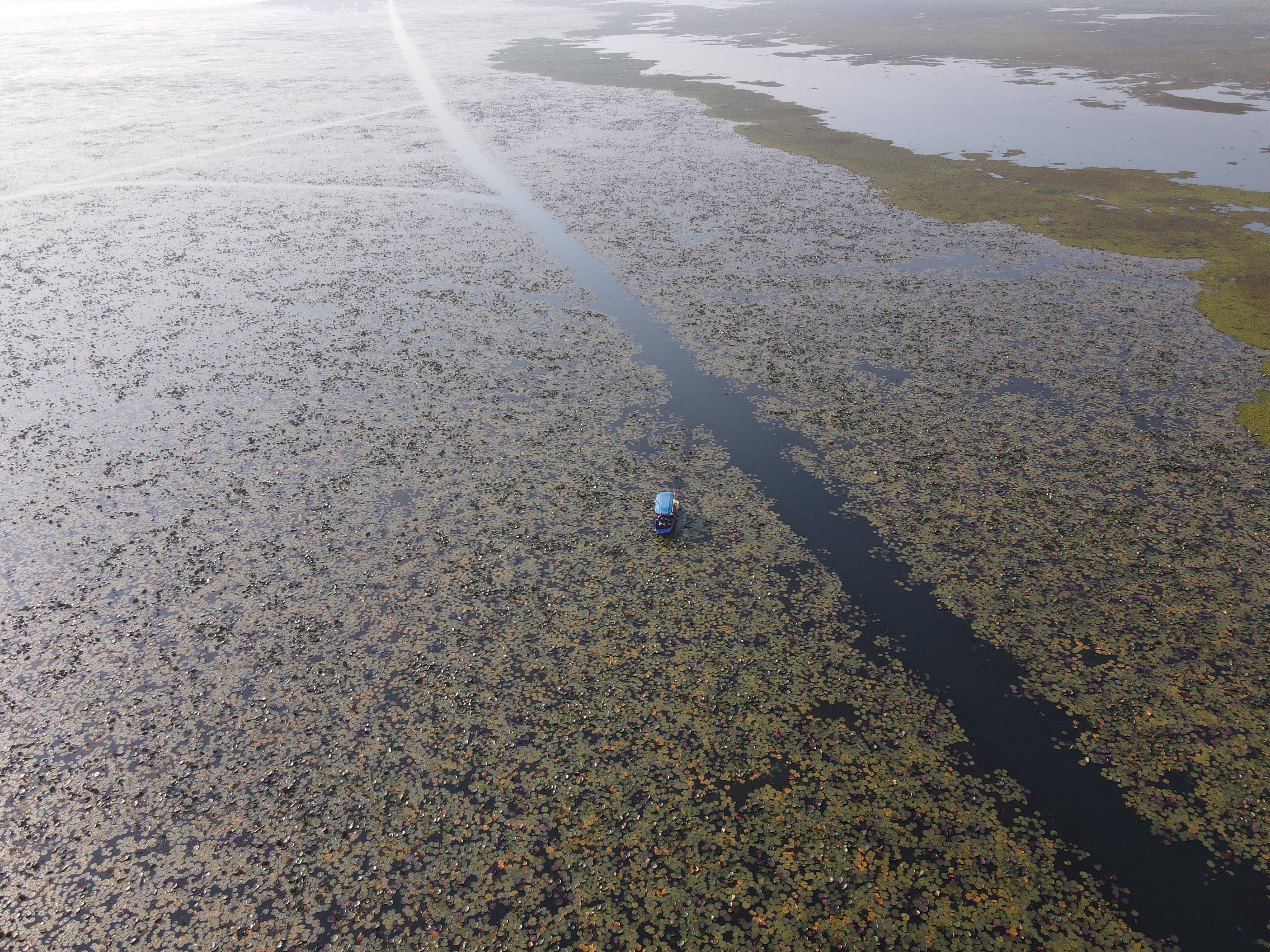
The Tourism Authority of Thailand describes the lake as a natural water source rich in fish, birds and aquatic plants, covering around 22,500 rai - roughly 36 square kilometres.
When the flowers are in bloom, the effect is spectacular.
From a distance, it can look as though someone has painted huge sections of the lake pink.
The best time to see the flowers
Naturally, there is a catch.
The lake isn’t covered in flowers all year round.
The flowering season is seasonal, with the most impressive displays traditionally associated with the cooler months. Tourism Authority of Thailand information highlights December to February as the period when visitors can see the lake covered in flowering lilies, while another TAT guide describes the flowering period as extending from around October through March.
So if you’re specifically planning a trip to see the Red Lotus Lake at its most spectacular, timing matters.
This isn’t necessarily a case of simply turning up in Udon Thani and expecting to find a sea of flowers.
Nature doesn’t work to our travel itinerary.
Why is it called the Red Lotus Sea?
The name Talay Bua Daeng translates roughly as Red Lotus Sea, and once the flowers are blooming it’s not difficult to understand why.
The lake can become covered with enormous numbers of flowering water lilies, creating large patches of colour across the surface.
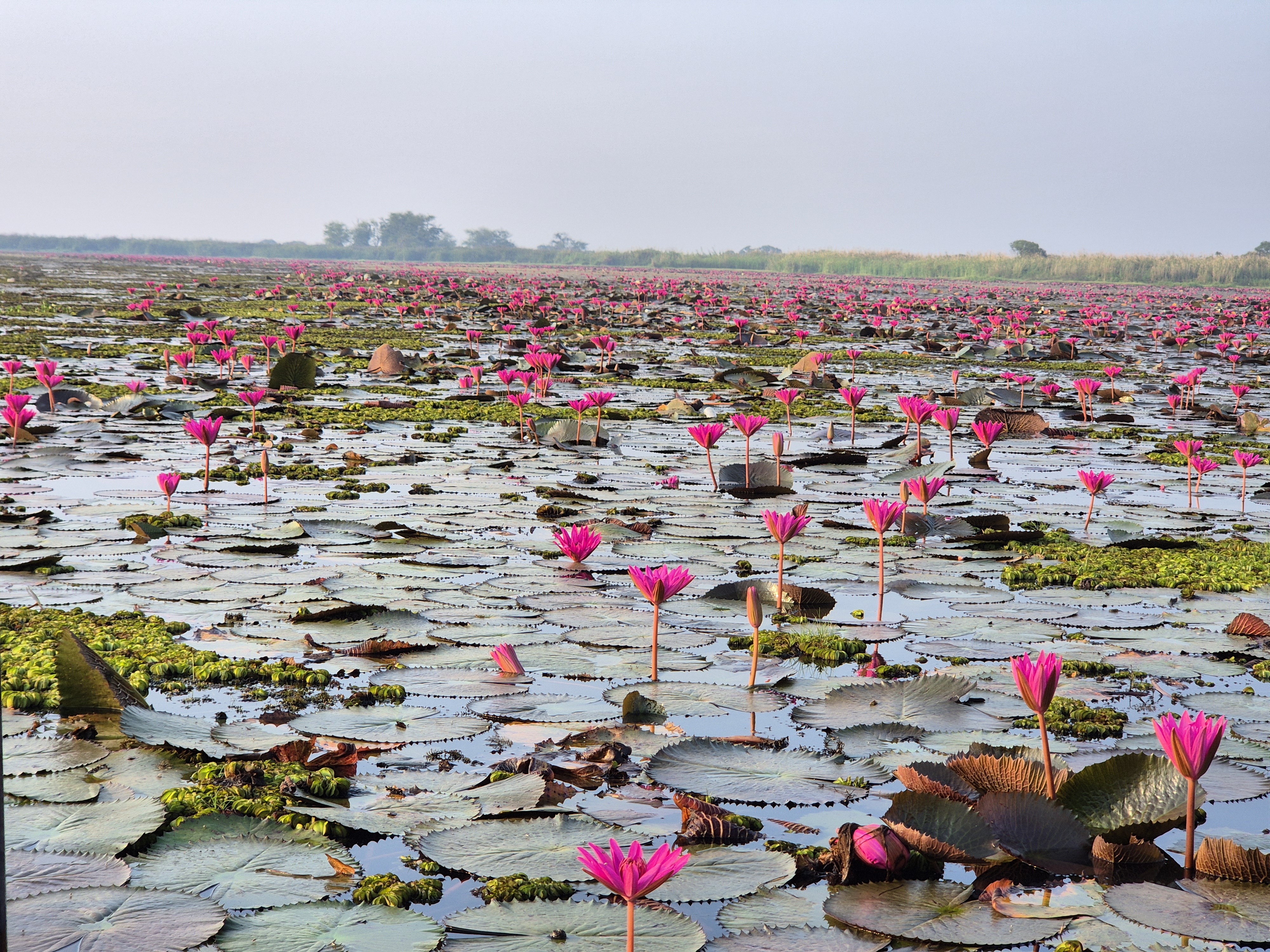
From ground level, you can see the flowers stretching away across the water.
But the real experience comes when you get out onto the lake.
That’s when you start to appreciate the scale of the place.
You’re not looking at a pond filled with flowers.
You’re surrounded by a huge wetland landscape with flowers stretching in every direction.
Exploring the lake by boat
The best way to experience Red Lotus Lake is from the water.
Boats take visitors out onto the lake, allowing you to get much closer to the flowers and explore areas that you simply can’t reach from the shore.
And this is where the experience becomes much more interesting than simply stopping at a viewpoint and taking a few photographs.
The boat moves slowly through the water, with lotus flowers appearing alongside you and stretching into the distance.
It’s peaceful, colourful and slightly surreal.
And, obviously, it’s also exactly the sort of place where having a camera becomes rather useful.
Red Lotus Lake is more than just flowers
It’s easy to think of Red Lotus Lake as simply a giant field of flowers.
But the lake itself is an important natural environment.
Nong Han is home to fish, birds and a variety of aquatic plants, and the surrounding wetland supports a considerable amount of wildlife. The Tourism Authority of Thailand specifically highlights the lake’s fish, birds and aquatic plant life alongside its famous flowers.
That makes the experience about more than just getting the perfect photograph.
You’re travelling through a living wetland.
The flowers are simply the spectacular part that everyone comes to see.
When should you visit Red Lotus Lake?
If you’re visiting specifically for the flowers, early morning is the time to aim for.
The flowers generally open in the morning, making an early boat trip the best opportunity to see them at their most impressive.
It also has another advantage.
Thailand can get very hot, particularly later in the day.
Being out on the lake in the cooler morning air is considerably more pleasant than trying to do the same thing in the middle of the afternoon.
The combination of morning light, cooler temperatures and flowering lilies is what makes an early visit so appealing.
Red Lotus Lake, Kumphawapi and Udon Thani
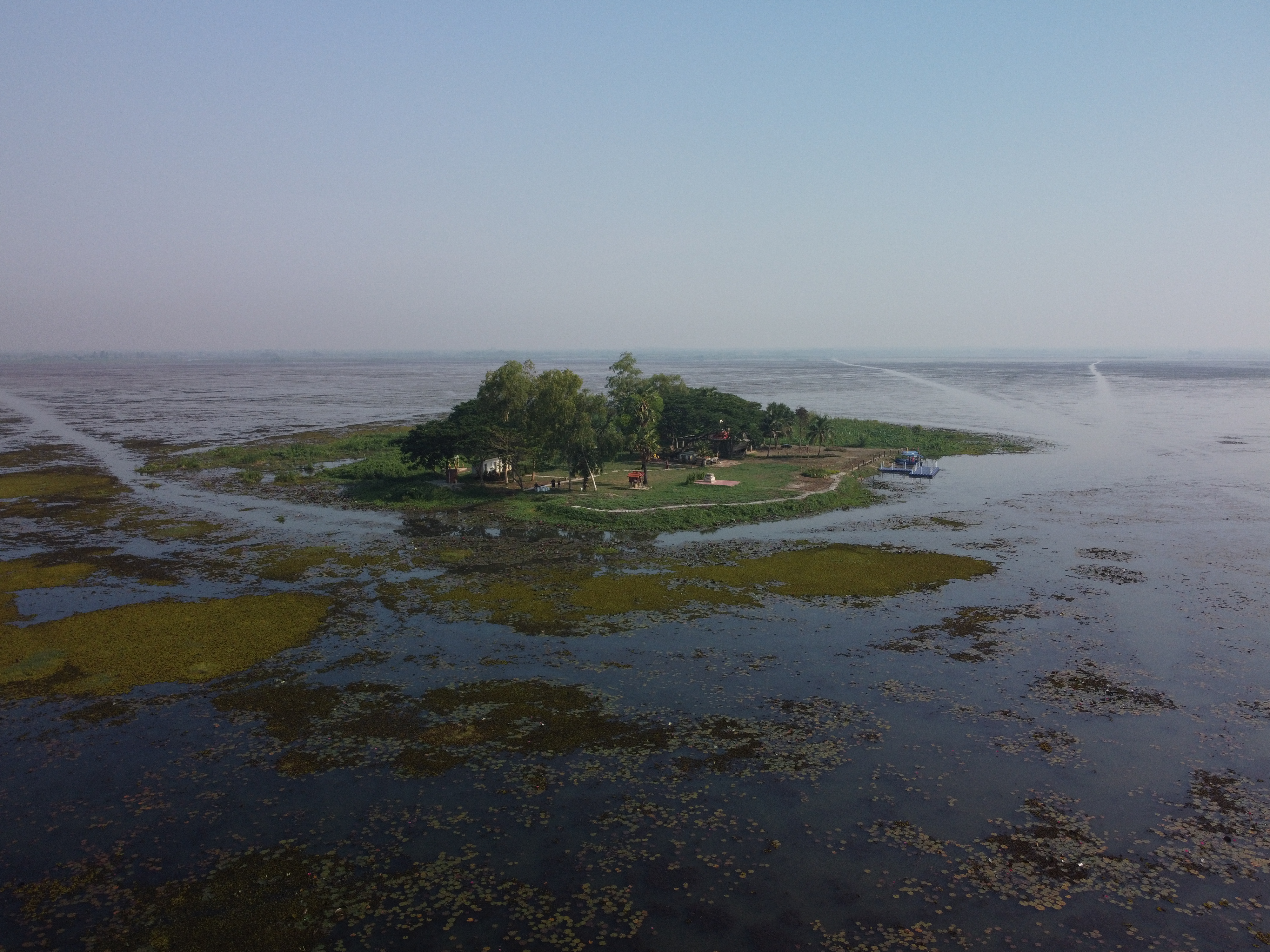
Red Lotus Lake is in Kumphawapi District, around the wider Udon Thani area of northeastern Thailand.
Udon Thani is perhaps better known as a gateway to other parts of Isan than as an international tourist destination in its own right, but the province has plenty to discover.
The Tourism Authority of Thailand includes Red Lotus Sea among its recommended attractions in Udon Thani and highlights the province’s mix of natural, cultural and historical attractions.
And that’s one of the things I enjoy about travelling around this part of Thailand.
You don’t necessarily have to follow the usual tourist trail.
There are places like this tucked away around the countryside that can be every bit as memorable as the famous destinations.
My visit to Red Lotus Lake
I think Red Lotus Lake is one of those places where the experience is difficult to explain without actually seeing it.
You can say:
“It’s a lake covered in red lotus flowers.”
But that doesn’t really convey what it feels like when you’re sitting in a boat surrounded by them.
The scale is what surprised me.
It’s not just a few flowers growing around the edge of a lake.
There are flowers stretching away across the water, with the boat slowly making its way through them.
And that’s why I wanted to film it.
Watch my Red Lotus Lake video
Is Red Lotus Lake worth visiting?
If you’re in the Udon Thani area during the flowering season, I’d say definitely.
It’s different from the temples, markets and city attractions you might normally associate with Thailand.
There’s no giant monument to climb.
No ornate temple covered in gold.
No huge shopping centre.
Just a boat, a lake and thousands upon thousands of flowers.
And sometimes that’s more than enough.
It’s also a particularly good destination if you enjoy photography or video.
The flowers, reflections, boats and changing morning light give you plenty to work with.
Even if you’re not carrying a camera, though, it’s difficult not to appreciate the view.
A different side of Thailand
One of the reasons I enjoy exploring northeastern Thailand is that you keep finding places that aren’t necessarily on everyone’s itinerary.
Red Lotus Lake is a perfect example.
It isn’t the Thailand of tropical beaches and busy tourist resorts.
It’s a huge wetland in Isan, surrounded by countryside, where a seasonal explosion of flowers turns the lake into something genuinely spectacular.
And that’s perhaps my favourite kind of travel.
Find somewhere interesting.
Take the camera.
See what happens.
Red Lotus Lake - Quick Facts
Name: Red Lotus Lake / Red Lotus Sea Thai: Talay Bua Daeng (ทะเลบัวแดง) Location: Kumphawapi District, Udon Thani Province, Thailand Region: Isan / Northeastern Thailand Known for: Thousands of flowering pink/red water lilies Best season: Generally the cooler months, with peak flowering often around December–February Best time of day: Early morning Best way to see it: By boat Lake: Nong Han
Final thoughts
Red Lotus Lake is one of those places that reminds me why I enjoy travelling around Thailand.
You don’t always need a famous landmark.
Sometimes it’s the unexpected places that make the best memories.
A lake in northeastern Thailand.
A boat early in the morning.
Flowers stretching as far as you can see.
And a camera pointed at it all.
That’s Talay Bua Daeng - Red Lotus Lake, Kumphawapi, Udon Thani.
And here’s the video from my visit if you haven’t watched it yet.
Comments